
 Fr. Joseph Whalen, our founder, blessed the above video asking God to give his healing blessing to all who watched it in the most Holy Name of Jesus Christ. (if you have the St. Raphael oil please put a cross shape on your forehead then watch it) This was his favorite healing prayer.
SEPTEMBER
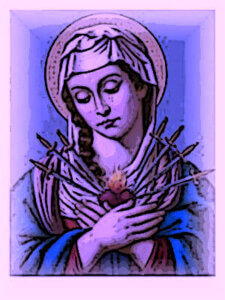 The month of September is dedicated to Our Lady of Sorrows, whose memorial the Church celebrates on September 15. September falls during the liturgical season known as Tempus per Annum or Ordinary Time (formerly Time After Pentecost), which is represented by the liturgical color green. Green is a symbol of hope, as it is the color of the sprouting seed and arouses in the faithful the hope of reaping the eternal harvest of heaven, especially the hope of a glorious resurrection. The liturgical color green is worn during prayer of Offices and Masses of Ordinary Time.
The Holy Father’s Intentions for the Month of SEPTEMBER 2026
The Holy Father’s Intentions for the Month of SEPTEMBER 2026
For the care of water: Let us pray for a just and sustainable management of water, a vital resource, so that everyone may have equal access to it. (See also https://popesprayerusa.net.)

O God, who founded all the commands of your sacred Law upon love of you and of our neighbor, grant that, by keeping your precepts, we may merit to attain eternal life. Through our Lord Jesus Christ, your Son, who lives and reigns with you in the unity of the Holy Spirit, God, for ever and ever.
https://oblatesusa.org/category/prayers/
ORDINARY
TIME:
SEPTEMBER 26th
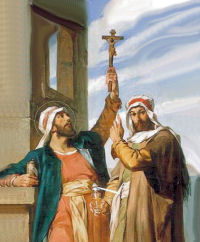 This is one of the most ancient feasts of the Church, and these two martyrs have been honored in the East and West in many ways, including the building of churches in their honor in Rome and Constantinople. Along with St. Luke, they are the patron saints of doctors. Little is known of their true history, but the legend that has come down to us is of very early origin.
—Excerpted from The One Year Book of Saints by Rev. Clifford Stevens
-
Contemplate how these brothers imitated Christ by healing the WHOLE person, both body and soul.
-
A Christian is generous: with his time, with his talents, with his money. Sts. Cosmas and Damian practiced medicine without charging others, looking upon this as a Christian service to others. I may not be able to imitate them in this, but my own spirit of generosity should be a clear part of my Christian witness.
-
Pray for those in the medical field.
-
Read more about Sts. Cosmas and Damian:
-
See about the the Roman Church dedicated to Cosmas and Damian.
-
Find out more about the miracles attached to the relics of Cosmas and Damian. There are different relics in various locations, including Saint Michael’s Church in Munich, Germany and Rome.
-
If you are close to Cambridge, Massachusetts on September 26, drop in on the annual Italian festival of the healing of Saints Cosmas and Damian which has been held since 1926 in September, close to their feast day.
-
See Catholic Cuisine for a food idea for the Holy Twins.
 Have you ever been reluctant to ask a question? Maybe you didn’t want to look dumb or be rebuked. Or maybe you were afraid of what the answer might be. Whether you’re at school or work, with friends or online, it can take courage to admit what you don’t know.
Psalm 90:3-6, 12-14, 17

(Hymn at Lauds)
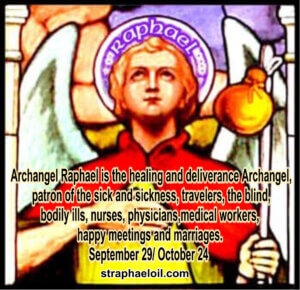
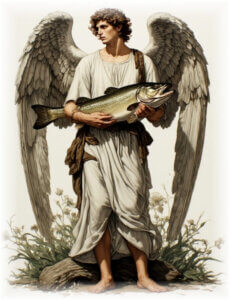
The feast day of Raphael was included for the first time in the General Roman Calendar in 1921, for celebration on October 24. With the 1969 revision of the General Roman Calendar, the feast was transferred to September 29 for celebration together with archangels Saints Michael and Gabriel.
St. Raphael in the traditional calendar (October 24) — which continues to be observed not only in communities which follow the Extraordinary Form of the Roman Rite , but also in those locales where St. Raphael is a patron.

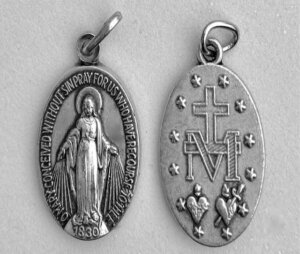
In 1830, one of the apparitions sanctioned by the Roman Catholic Church occurred in the chapel of the Daughters of Charity of St. Vincent de Paul, Rue de Bac, Paris. There were three visions given to Saint Catherine Laboure who, at the time of the first one, was a novice in the order. She was awakened at 11:30 PM on the eve of the Feast of St. Vincent de Paul, by a “shining child” who led her to the chapel where she saw Our Lady, who spoke to her for two hours about the difficult task that lay ahead. Four months later, on November 27 Catherine had the second vision wherein she saw a three-dimensional scene of the Blessed Virgin standing on a white globe with dazzling rays of light streaming from her fingers and she heard a voice say:
“There now formed around the Blessed Virgin a frame rather oval in shape on which were written in letters of gold these words: ‘O Mary conceived without sin, pray for us who have recourse to Thee’
This sacramental from Heaven was at first called simply the Medal of the Immaculate Conception, but began to be known as the Miraculous Medal due to the unprecedented number of miracles, conversions, cures, and acts of protection attributed to Our Lady’s intercession for those who wore it.
Sister Catherine became Saint Catherine in 1947. The church instituted recognition of the apparition in which the Miraculous Medal first appeared for November 27, 1830. Millions of the Miraculous Medal have been distributed, and many graces and miracles have been received through this devotion to Our Lady.
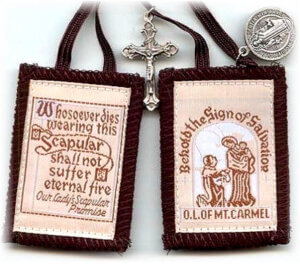
BROWN SCAPULAR OF MT. CARMEL
Virgin Mary’s promise to Saint Simon Stock
July 16, 1251″Wear it devoutly and perserveringly,” she says to each soul, “it is my garment. To be clothed in it means you are continually thinking of me, and I in turn, am always thinking of you and helping you to secure eternal life.”
The scapular is an external sign of the filial relationship established between the Blessed Virgin Mary, Mother and Queen of Mount Carmel, and the faithful who entrust themselves totally to her protection, who have recourse to her maternal intercession, who are mindful of the primacy of the spiritual life and the need for prayer.
THE SABBATINE PRIVELEGE
The blessed Virgin of Mt. Carmel has promised to save those who wear the scapular fromthe fires of Hell; She will also shorten their stay in Purgatory if they should passfrom this world still owing some temporal debt of punishment.
The Blessed Virgin appeared to him and speaking of those who wear the Brown Scapular said: “I, the Mother of grace, shall descend on the Saturday after their death and whomsoever I shall find in Purgatory, I shall free, so that I may lead them to the holy mountain of life everlasting.”
Pope Benedict XV proceeded to grant an indulgence of 500 days for each time the cloth Scapular is kissed”. On July 16th, the Scapular feast, while addressing the seminarians of Rome, Benedict XV said: “Let all of you have a common language and a common armor: the language, the sentences of the Gospel; the common armor, the Scapular of the Virgin of Carmel, which you all ought to wear and which enjoys the singular privilege of protection even after death.”
The Brown Scapular | A Sacramental
“One of the most remarkable effects of sacramentals is the virtue to drive away evil spirits whose mysterious and baleful operations affect sometimes the physical activity of man. To combat this occult power the Church has recourse to exorcism, and sacramentals” (The Catholic Encyclopedia., 1913, VXIII, p. 293).
The Brown Scapular | A True Story
You will understand why the Devil works against those who promote the brown scapular when you hear the true story of Venerable Francis Yepes. One day his Scapular fell off. As he replaced it, the Devil howled, “Take off that habit which snatches so many souls from us! All those clothed in it die piously and escape us!” Then and there Francis made the Devil admit that there are three things which the demons are most afraid of: the Holy Name of Jesus; theHoly Name of Mary and the Holy Scapular of Carmel.“Modern Heretics make a mockery of wearing the Scapular. They decry it as so much trifling nonsense.” – St. Alphonsus LigouriMary, Mother of God and Our Mother“When Mary became the Mother of Jesus, true God and true Man, She also became our Mother. In His great mercy, Jesus wished to call us His brothers and sisters, and by this name He constituted us adopted children of Mary.” – St. John BoscoOver the years there have also been many miracles associated with wearing the brown scapular.
*If you would like a brown scapular click here: